
Why Your Website Isn't Showing Up Online
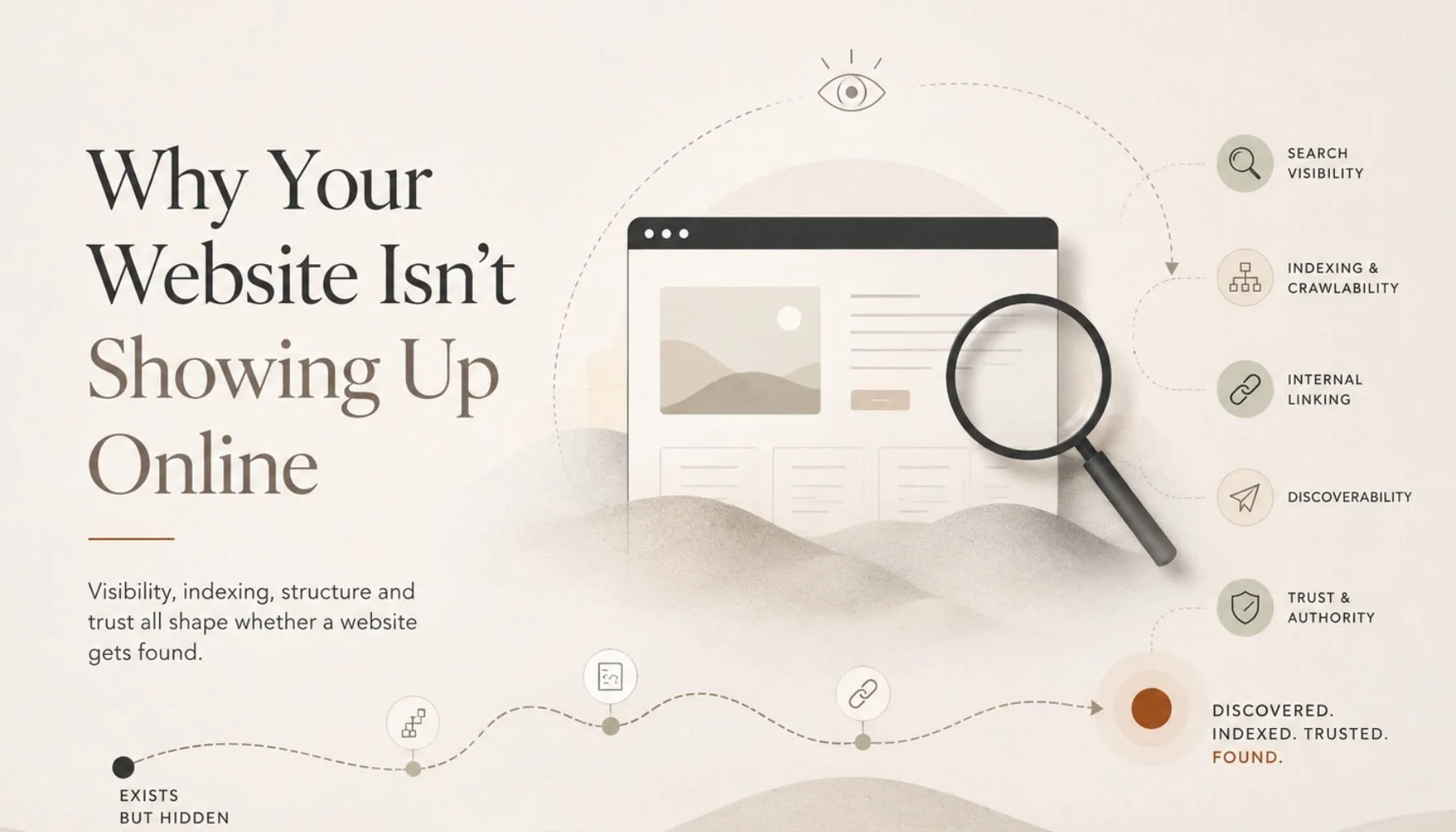
Publishing a website is only the first step. To be found, your site needs to be visible to search engines, clear to visitors, and connected to the wider web.
A business launches a website. The design looks good, the pages are live, the contact form works, and the site feels finished. Then weeks pass and very little changes. The right people are not arriving. Inquiries are not increasing. When the owner searches for the business, some pages appear, but important services are missing entirely.
The problem is usually not one single thing. A website has to be published, discovered, indexed, understood, trusted, and connected before it can start working as a visibility asset. Most sites that "don't show up" are failing quietly at one or more of these stages, and each stage has its own fix.
This article walks through the most common reasons a live website stays invisible and what to check at each step.
1. Your website may be live, but not indexed
There is a difference between a page being live and a page being indexed, and many business owners have never had a reason to learn it.
Live means people can visit the page if they have the link. "Indexed" means Google has crawled the page, stored it, and can show it in search results. A page can be live for months without being indexed. Until it is, it does not exist as far as search is concerned.
This is why Google Search Console matters. It is free, it connects directly to your site, and it shows you exactly which pages Google can and cannot show.
What to do:
Set up Google Search Console and verify your site
Submit your sitemap
Open the Page Indexing report
Look for pages marked "Discovered, currently not indexed" (Google knows the page exists but has not crawled it yet)
Look for pages marked "Crawled, currently not indexed" (Google visited the page but chose not to store it, often a sign the content looks thin or duplicative)
Use URL Inspection on your most important pages
Request indexing after fixing issues
If your key service pages sit in either of those "not indexed" categories, no amount of design work or social posting will fix your search visibility. Start here.
2. Google may not understand what each page is about
Indexing gets you into the library. It does not tell anyone what your book is about.
A page that says "we help ambitious brands grow" may sound appealing, but it leaves the essentials unanswered. What service is actually offered? Who is it for? Where does the business work? What problem does it solve, and what proof exists that it has solved it before?
If a human visitor cannot answer those questions in thirty seconds, a search engine cannot either.
What to do:
Give each important service its own clear section or page
Use plain service language instead of positioning language
Add FAQ sections that answer real client questions
Add examples and case studies
Link related pages to each other
Make page titles and meta descriptions specific
Compare the two:
Less clear: Growth for ambitious brands
Clearer: Brand Strategy, Website Design and Visibility Support for Growing Businesses
The first could belong to a gym, a VC fund, or a coaching program. The second tells both a person and a search engine exactly what happens here.
3. Your website may not match how people search
Search behavior has changed, and many websites were written for the old version of it.
People used to type short phrases: "branding agency," "website designer," "SEO consultant." Those searches still happen, but they are dominated by large players and directories, and they tell you almost nothing about intent.
Many searches now look more like questions:
"why is my website not showing up on Google"
"how do I get my service business found online"
"how to improve website visibility without running ads"
And people increasingly ask AI tools even longer ones: "Who can help me clarify my brand, improve my website and get found online?" or "What should I fix if my website is live but not getting traffic?"
A website built only around short keywords has nothing to offer these longer, more specific searches. A website that answers real questions does.
What to do:
Write content around the actual questions your clients ask
Add FAQ sections to service pages
Use blog posts to work through buyer problems in depth
Use case studies to show context and outcomes
Treat short keywords as a starting point, not the whole strategy
4. Your website needs internal paths
A site should not be a set of disconnected pages. Google, AI tools, and human visitors all move through a site by following links, and a page with no links pointing to it is easy to miss and hard to trust.
What to do:
Link service pages to relevant case studies
Link case studies back to the services they demonstrate
Link blog posts to the service pages they relate to
Link related articles to each other
Make sure every important page is reachable from navigation or from visible links on other pages
A blog post about content consistency should point to the service that helps with it. A case study should point to the strategy, identity, or website work it came from. Each link tells search engines which pages matter and tells visitors where to go next. A page that nothing links to sends the opposite signal.
5. Your website needs signals from outside the website
A website is the destination. People still need roads leading there.
LinkedIn posts, newsletter mentions, directory profiles, podcast interviews, guest articles, and partner pages all create paths back to your site. They help in two ways. They send real visitors, and they create evidence that the business exists beyond its own domain. A site that no external source ever mentions looks isolated to search engines and to cautious buyers alike.
What to do:
Link to your website from your LinkedIn profile and posts
Republish or adapt useful ideas as LinkedIn or Substack articles
Add your website to relevant directory profiles
Link to case studies when sharing completed work
Use newsletters to send readers to specific pages, not just the homepage
Keep the business description consistent across every public profile
That last point matters more than it seems. If your LinkedIn says one thing, your directory listing says another, and your website says a third, every system trying to understand your business gets a blurrier picture.
6. AI answers are changing visibility too
Search is also changing because more people now ask AI tools for explanations, comparisons, and recommendations. These tools rely on clear website content, trusted sources, third-party mentions, and consistent information. If your business is hard to understand online, it is harder for an AI tool to describe or recommend it accurately and easier for it to recommend a competitor whose site leaves no room for doubt.
The encouraging part: almost everything that helps AI tools understand a business is the same work described above. Clear service descriptions, helpful educational content, FAQ sections, consistent information across platforms, and proof through case studies and mentions. Vague language that could apply to any business is the one thing to actively remove.
7. What to check first
If your website is live but invisible, work through this list in order:
Check Google Search Console
Make sure your sitemap is submitted
Inspect your most important pages
Review page titles and SEO descriptions
Search your own business name
Search your main service phrases
Check whether service pages link to case studies
Check whether blog posts link to services
Review your LinkedIn, newsletter and directory links
Ask whether each page clearly says who it helps and how
Most businesses that do this find the problem is not mysterious. It is usually a handful of unindexed pages, vague page titles, missing internal links, and a website no external platform points to.
A website does not become visible just because it exists
It needs to be findable, readable, connected, and useful. Search engines need to access it. Visitors need to understand it. AI tools need enough context to describe them. Other platforms need to create paths back to it.
That is why website visibility is no longer only a technical SEO task. It is part strategy, part content, part structure, and part consistency, which also means it is fixable without starting over.
If your website is live but not bringing the right people in, the next step may not be a redesign. It may be a visibility review.
Related reading: Your SEO Might Be Fine. Your AI Visibility Probably Isn't.
