
Ranking on Google Used to Be the Whole Game.
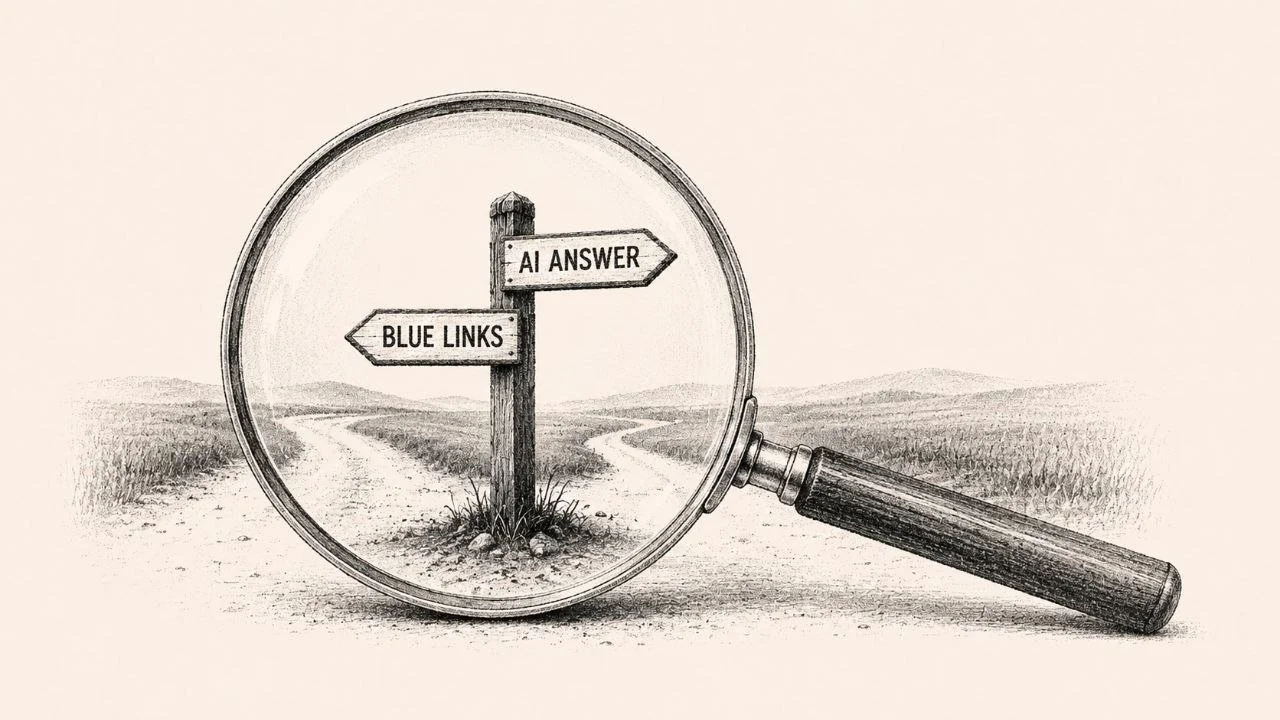
For years, visibility meant ranking in search results. Increasingly, visibility means being included in the answer.
For twenty years, visibility meant ranking on Google. People typed a question, scanned ten blue links, clicked one.
That's not how it works anymore for a growing number of searches. ChatGPT, Perplexity, and Gemini don't return a list of links. They return one answer, built from whatever sources they've decided are worth repeating.
I've watched this play out with our own clients. A business ranks fine on Google and still doesn't come up when someone asks an AI tool the same question, because AI tools aren't scanning a list and picking the top result. They're reading the actual content and deciding what's worth saying out loud.
Here's a quick way to check where you stand right now
Open ChatGPT, Claude, Gemini or Perplexity and ask it a question your ideal customer would ask, something like "best [your service] for [your audience]." That single question already tells you more than most businesses know about their own AI visibility.
Look closely at what comes back. Did you show up at all? If you did, did the AI actually cite or link to your page, or just mention your name in passing, the difference between being trusted enough to point to and merely known to exist. Notice who showed up instead of you too; that's your real competitive set in AI search, which isn't always the same set you compete with on Google. And pay attention to fit: did the answer match what you actually do, or stretch your positioning to fit the question? A near-miss usually means your content doesn't define you clearly enough for AI to place you right.
Run this with two or three different phrasings of the same underlying question. A single prompt can miss. A pattern across a few tells you something real.
Most business content reads fine and says nothing
AI tools have made it easy to write a passable article about almost any topic in minutes. That's flooded the web with posts that sound okay but don't say anything a competitor couldn't have written too. AI search has started filtering for the opposite: content built on something real, a specific decision, a number, an outcome someone actually lived through.
Google calls the first kind commodity content. The second kind is what actually gets cited.
Ask yourself one question about anything you publish: could a competitor write this exact piece without talking to anyone on your team? If yes, it's commodity content, and there's no reason for AI search to pick yours over the other ten versions already online.
Where this material actually comes from
Every business already has this material. It's usually not sitting in a content calendar. It's sitting in the heads of the people doing the work: the specific reason a project succeeded, the number that surprised the team, the mistake that taught them something competitors haven't learned yet.
We call the process of pulling that out and structuring it properly a content extraction audit, sitting with the people who actually did the work and turning what's in their heads into something search engines and AI tools can read and trust. It's slower than writing generic posts, but it's the only version that still holds up six months later.
We start with what's broken, not what's missing
Before any of this matters, the basics often need fixing first. A surprising number of businesses are sitting on content opportunities with no technical foundation underneath them: pages that load slowly, no clear heading structure, no internal linking, nothing telling search engines or AI tools what the page is actually about. Non-commodity content on a broken foundation still underperforms. We start there, fix what's structurally missing, and only then move to the content itself.
Then we build content that doesn't expire
Once the foundation is sound, the next phase is building a set of cornerstone articles, the kind of content that doesn't expire. Not "5 trends for this year," but the specific knowledge, decisions, and results that remain true and useful regardless of when someone finds them. This is the layer AI search tools return to again and again, because it keeps being accurate.
Then we go where people are already talking
A blog by itself rarely moves the needle. The businesses that build durable visibility show up consistently across the platforms their audience actually uses, not just their own website. That might mean LinkedIn posts and longer-form articles, a Reddit community built around real operator questions, a Facebook group, a Discord server for power users, or some other channel entirely depending on where that specific audience already gathers. The content adapts to the platform; the underlying material, the real expertise, stays the same.
From there, it's your call how involved we stay
Once the evergreen base exists, most clients choose one of two paths. Some bring us on as an ongoing partner, continuing to extract new material and publish it consistently across platforms as the business and its expertise keep evolving. Others prefer to take it from there: we build content templates and frameworks based on what already worked, then hand that system to your in-house team to run independently. Either way, you end up with a repeatable way to keep producing content that's actually worth citing, whether we're running it or your team is.
Why this matters now
The businesses publishing real, specific, first-hand content today are the ones AI tools are learning to cite as the underlying models train and re-train. Waiting until the shift is obvious means competing for the same citations against businesses that started building this evidence months earlier.
You already ran the check above. If your business didn't show up, or showed up framed wrong, let's talk about fixing your ranking, visibility, and AI search, all of it.
