
AI Citations and Search Rankings Are Not the Same: What Businesses Need to Measure in 2026
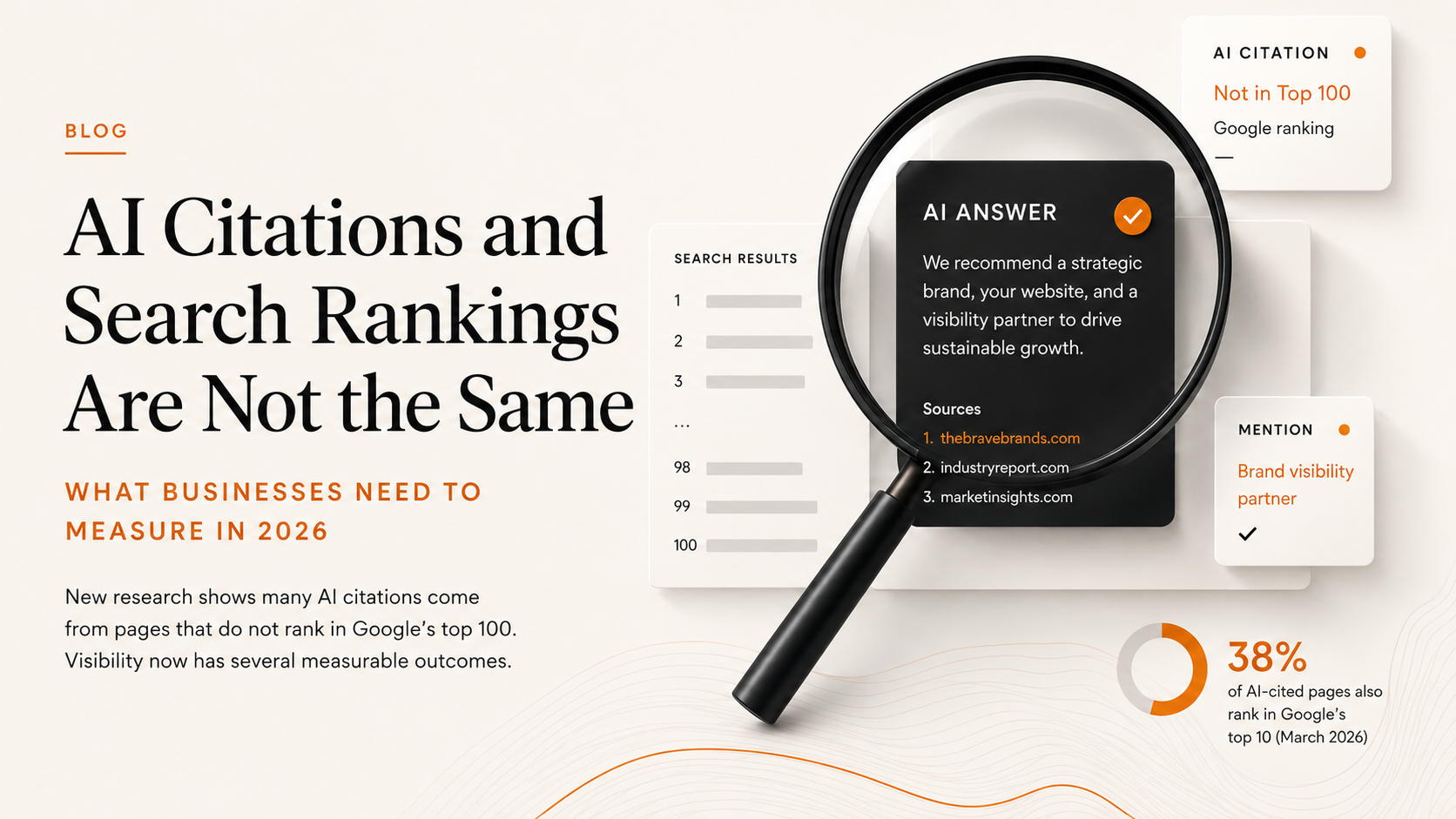
A business can rank well in Google and remain almost absent from AI-generated answers.
The reverse can happen too. A page that sits outside the strongest organic positions may still be selected as a source inside an AI response.
That difference is becoming easier to measure.
In March 2026, Ahrefs analyzed 863,000 Google search results containing four million URLs cited in AI Overviews. Only 38 percent of those cited pages also appeared in Google’s top ten results for the same query. Around 37 percent did not rank within the first 100 traditional results.
Search rankings and AI citations clearly overlap, but one does not reliably predict the other.
For businesses, this creates a wider visibility question. Ranking remains important, but it no longer tells you everything about whether your company is being discovered, named, cited, or recommended.
What is the difference between a ranking, a citation, and a mention?
A search ranking records where a page appears within a conventional results page.
An AI citation occurs when an AI-generated response uses a webpage as a visible source.
A brand mention occurs when the answer names the company, product, or person in its response.
These outcomes are related, but they are not interchangeable.
A June 2026 Semrush study examined 3,981 domain appearances across ChatGPT, Gemini, Google AI Overviews, and Google AI Mode. Almost 62 percent of cited appearances were what the researchers called “ghost citations”: the page appeared as a source, but the answer did not name the brand. Only 13.2 percent of appearances combined a citation with an explicit brand mention.
This matters because a website can contribute information to an answer without receiving visible recognition. It can also be named as a recommended business without its website being cited.
A useful AI visibility assessment therefore needs to track several outcomes:
whether the brand appears
how it is described
whether it is recommended
whether one of its pages is cited
whether the citation includes a clickable link
which external sources shape the answer
Counting citations alone gives an incomplete picture.
Why can a page be cited without ranking highly?
Google’s traditional results and AI-generated answers do not assemble information in exactly the same way.
Search rankings organize pages around a query using Google’s ranking systems. AI-generated results may search for several related questions, retrieve passages from different sources, and combine those passages into one response.
The precise process differs between platforms and continues to change. There is no universal AI ranking shared by ChatGPT, Gemini, Perplexity, Google AI Mode, and AI Overviews.
Current research shows how wide those differences can be.
In Semrush’s 2026 study, ChatGPT cited a source in 87 percent of the appearances examined but named the associated brand in only 20.7 percent. Gemini showed the opposite pattern, frequently naming brands while providing far fewer source links. The same study found almost no overlap between the brands ChatGPT cited and the brands Gemini named for identical prompts.
This means a business cannot test one platform once and treat the answer as its permanent AI position.
The prompt, platform, country, date, and mode can all influence what appears.
What makes information easier for AI systems to use?
No publisher can guarantee selection inside an AI answer. There are, however, practical ways to make information easier to find, understand, verify, and reuse.
Clear answers
A page should answer the question it claims to address.
Direct headings, focused paragraphs, and specific language help readers understand the page quickly. They also give retrieval systems clearer passages to interpret.
A section titled “How long does a brand strategy project take?” is more useful than a vague heading such as “The journey ahead.”
The first sentence should begin answering the question rather than delaying the useful information.
Original knowledge
AI visibility research increasingly points towards useful, original material rather than recycled commentary.
This 2026 Semrush study examined 89,000 LinkedIn URLs cited across ChatGPT Search, Google AI Mode, and Perplexity. Approximately 95 percent of the cited posts were original rather than reshares. Educational and advice-led content accounted for the majority of cited material, while first-hand explanations and practical knowledge performed particularly well.
This supports an important distinction. Rewriting a widely reported statistic may help explain a subject, but it rarely gives other publishers or AI systems a compelling reason to cite your business.
Original observations, experiments, data, case studies, and documented results create that reason.
Consistent brand information
An AI system may encounter a business through its website, LinkedIn page, directory profile, case studies, articles, reviews, and third-party coverage.
Those sources should describe the business consistently.
A company becomes harder to interpret when one page calls it a branding agency, another describes it as a marketing consultancy, and a third lists services that no longer appear on the website.
Clear business information should establish the following:
who the company is
what it does
who it helps
where it works
what evidence supports its claims
Specific language is more useful than broad positioning statements that could describe almost any company.
Accessible and indexable pages
AI visibility still depends on having information that systems can access.
Important service pages should be live, internally linked, included in the sitemap, and available to search crawlers. Google Search Console remains useful for checking whether key pages have been discovered and indexed.
Technical accessibility does not guarantee a citation, but inaccessible pages have little chance of contributing to a search or retrieval result.
Independent corroboration
A business should not rely entirely on its own website to establish credibility.
LinkedIn is already a significant source in AI-assisted discovery. In Semrush’s 2026 analysis of 325,000 prompts, LinkedIn appeared in an average of 11 percent of responses across ChatGPT Search, Google AI Mode, and Perplexity. The platform was the second most frequently cited domain in that dataset.
For professional services businesses, this makes external consistency especially important. Company pages, individual expertise, articles, interviews, directories, partnerships, client references, and relevant media coverage can all help reinforce what the business says about itself.
Does traditional SEO still matter?
Yes.
The 2026 Ahrefs data does not show that rankings have become irrelevant. It shows that the relationship between rankings and citations is no longer straightforward.
Thirty-eight percent of AI Overview citations still came from pages that ranked in the traditional top ten. A further share came from positions below the first page. Strong organic visibility therefore remains one route into AI-generated answers, but it is no longer the only route.
Traditional SEO continues to support:
discovery
crawling
indexing
page structure
internal linking
topical relevance
authority
website usability
AI visibility adds further questions:
Is the business named?
Is the description accurate?
Which sources support that description?
Does the business appear for commercially relevant prompts?
Is it cited, recommended, or only used anonymously as a source?
Does the answer change between platforms?
The strongest visibility strategy measures both environments.
What should a business measure in 2026?
AI visibility should begin with a defined baseline.
Choose questions that reflect how potential clients actually search. These may include:
who can help with a particular problem
which company offers a specific service
how to choose between available providers
what a service should include
which specialists work in a location or industry
why a business is struggling to be found
Run the same prompts across the platforms relevant to the audience.
For each result, record:
platform
exact prompt
date
market or country
whether the brand appears
where it appears in the answer
how it is described
whether it is recommended
whether its website is cited
which other sources are cited
which competitors appear
Repeat the test over time.
One answer is an observation. A repeated test begins to reveal a pattern.
Five checks you can make this month
1. Test the questions your clients ask
Use ChatGPT, Gemini, Perplexity, and Google AI Mode where available. Record the exact prompt and result rather than relying on memory.
2. Check how clearly your website defines the business
A visitor should be able to identify what you do, who you help, and where you operate without interpreting abstract brand language.
3. Compare your key profiles
Review your website, LinkedIn page, directory listings, author profiles, and other important references. Correct outdated services, inconsistent descriptions, and conflicting company information.
4. Review your most important content
Look for pages that provide an original answer, example, result, or viewpoint. General summaries may be useful, but they are less likely to establish your business as the source of something distinctive.
5. Confirm that your important pages can be found
Check indexing, sitemap submission, internal links, page status, and crawl accessibility. A page needs to be reachable before it can support wider visibility.
Visibility now has several measurable outcomes
A high Google position remains valuable.
An AI citation can also be valuable.
A brand mention, accurate recommendation, source link, or repeated appearance across commercially relevant prompts may each indicate something different.
Businesses need to understand which form of visibility they are earning, where it happens, and whether it contributes to recognition, traffic, trust, or inquiries.
BRAVE helps businesses examine that wider discovery system across their website, search presence, content, brand information, and AI-generated answers.
To understand where your business currently appears and what may be limiting its visibility, contact us for a visibility assessment.
